Melanie & Mike say... |
|
|
|
| the only Weekly Word-origin Webzine | |
Issue 94 |
July 24, 2000 |
Melanie & Mike say... |
|
|
|
| the only Weekly Word-origin Webzine | |
Issue 94 |
July 24, 2000 |
| Search | Home | FAQ | Links | Site map | Book Store | New | Ask Us | Theory | About |
Interested in sponsoring this site, advertising here or making a donation to keep the site running? |
"But what's this ablaut business?" we hear you ask. Well, one peculiarity of Indo-European languages is the ablaut inflection. This refers to the creation of new words by changing a vowel in an existing word. This may sound odd but we do it all the time. The past tense of sit is sat and when we sit we often sit on a seat. The past tense of drive is drove and, in the U.S., the past tense of dive is dove. This latter word is interesting as it has never existed in British English. The habit of forming ablaut inflections was obviously so ingrained that we keep inventing them.
The -le on the end of cripple may well indicate that it is
a "frequentative" form. Excuse us for introducing
another technical term but like ablaut it is really easy to
understand. A frequentative Mike's car was a little crumpled in the accident, too. Crumple is a frequentative form of crump, an obsolete verb which meant "to curl up" and is the origin of crumpet. Crump is also an ablaut form of crimp and cramp. Which reminds us... time for Mike to take his muscle relaxant pill. |
|
|||
|
From Bernadette:
Sure, we can give you a hand with this one. As a matter of fact, that's the etymological meaning behind surgery: to perform work with one's hands. It entered English from Old French in the 14th century. Even Chaucer used it in his Prologue in about 1386: "In al this world ne was ther noon hym lik To speke of phisik and of Surgerye." Surgery is a contracted form of chirurgery, the contraction having taken place in Old French (surgerie and cirurgerie). French took cirurgerie from Latin chirurgia "work of a surgeon", and the Latin derives from Greek kheirurgía "working by hand", from kher "hand" (as in words like chiropractor and chiroptera - the zoological name for the bat family, meaning "hand wing") and érgon "work" (source of erg and ergonomic). |
|||
|
Read about other words in our bookstore. |
|||
|
From Chris Arnold:
As the time of the large meal of the day varied so much it led to a great deal of confusion over names. Some people called this "large meal" term, dinner, while others used the word that had been applied originally to the evening meal, supper. In our experience, country folk tend to call "lunch" dinner, probably because they, until very recently, worked in the fields during the day and ate a large meal at lunch. They had to have a separate name for the evening meal, so they stuck with supper. City folk tend to call the evening meal dinner as it is usually their largest meal of the day, and they have lunch at midday. This is not universally true, though, and there are many regions of Britain where the large meal, eaten early in the evening is called tea. |
|||
From Ott Gaither:
Indeed we do, and your query is apt as we are in the midst of those particular days at the moment in the northern hemisphere - hot, brutally sunny days, when anything that isn't watered withers. Why are these known as the dog days of summer? It is at this season that the dog-star, Sirius, becomes visible just before sunrise (this is known as its heliacal rising). This has been recorded by man for millennia. The Romans knew this time of year as dies caniculus, and English translated the phrase directly from Latin. The Greeks knew this season by the same name. The term has been around for so long that people began associating it not with Sirius, but with a time of year when dogs seem to go mad (rabies is more prevalent in the summer when animals are active). The term first appears in the English written record in Sir Thomas Elyot's Dictionary of 1538. Why is Sirius known as the dog-star? It has been known as such for longer than the dies caniculus have been recognized. The Egyptian hieroglyph for Sirius is a dog, dating at least from 3285 B.C. Even the Phoenicians connected dogs with the star: they called it Hannabeah "the Barker". The Egyptians celebrated their new year when Sirius rose on the summer solstice (today it rises on August 10). It has been suggested that the star is connected with the dog because it was thought of by the ancients as the "guardian of the horizon and also the solstices" (this from Richard Hinckley Allen's Star Names: Their Lore and Meaning). The name Sirius is thought to derive from Greek seirios "sparkling". Today, most almanacs designate the dies caniculus as July 3 through August 11. |
|||
From
James:
The nerve of 'em! Well, we'll take care of
you, James. We'll try, anyhow. We're afraid you might be a bit
disappointed with the etymology of washer "metal disc".
While |
|||
From Laura Scundakis:
It really chafes our collective hide when we hear folk say miss-CHEEV-ee-us. It should be MISS-chiv-us. It is surprising to learn that the second (instead of the first) syllable was stressed until about 1700, and that might account for today's widespread mispronunciation, but it's hard to say for sure. The word itself means, etymologically, "coming to a head badly". That's an awful image, isn't it? It derives from Old French meschever, formed from mes- "wrongly" (cognate with English mis-) and chef "head". Yes, that's right, head chef is redundant! Mischievous dates from the 14th century, when it meant "unfortunate, disastrous". It then meant "harmful, damaging", and it wasn't until the 18th century that its meaning softened to "playfully malicious". Mischief is related to kerchief, which is, etymologically, a "head cover" (a contraction of cover chef), and to chief itself, which means, of course, "head person". |
|||
|
 Sez
You... Sez
You... |
|
From Kristy:
Yes, we run into these inaccuracies now and again. The only present-day Masses said in Latin that we're aware of (other than certain special occasions) are Tridentine Masses, and those aren't sanctioned by the Church. By the way, the reader who wrote last week about virgin mentioned the Immaculate Conception. This has nothing to do with Mary giving birth as a virgin. Instead it refers to her having been conceived without original sin. |
From Fiona:
And why should dragons breathe fire? If we examine medieval iconography we see that dragons do not always breathe fire and smoke, sometimes they breathe toads and snakes. This is because medieval artists were not content just to show a picture; they usually tried to tell a story, too. In this case, they were attempting to describe the poisonous fumes which emanated from dragons in legend. So, it wasn't really fire, it just looked like it in the paintings. Thanks for the further examples of how strange English can seem at times. |
From Noah:
Thanks for those quotations, Noah. Those jibe with what we've found. However, think about the phrases puddin' 'n' tame and puddin' 'n' tain: they mean nothing. Where did they come from? Probably from people hearing poont*ng (and perhaps not knowing what it meant) and converting that into something a little more recognizable. That would also explain why the phrase is only used as a proper name in those quotes. No one knew quite what to do with it other than that. (That's our semi-educated guess, anyhow.) You're probably right on the money in suggesting that Grandma (and the mother of reader John Burgess, who wrote in last week) got the rhyme "What's my name..." from the book or the song. |
From Georg Trimborn:
The New Testament was written in Greek, not Hebrew, and the Greek word was parthenos. As you suggest, this word meant simply "young girl". The shift in meaning to "chaste" exactly parallels the evolution of the English word maiden. Maidenhead originally meant "young-girl-ness". |
From John Burgess:
Yes, but we don't say "he overdosed on aspirins". We say "he overdosed on aspirin", even though some might say "Take two aspirins and call me in the morning". However, we hear "he overdosed on methamphetamines". As for fish and fishes, fish has been a collective singular since at least 1300. Apparently, in this case, folk have been (and still are) influenced by other collective animal words like fowl. |
From Teacia Babb:
From Jeff O'Rourke:
Thank you, both, for taking the time to write and tell us what you think about the site. |
From Susan Clarke:
Thanks, Susan! |
| Laughing Stock |
Children's Books
Thanks to Kurt Geske for forwarding these to us |
Comments, additions? Send to
Melanie & Mike: melmike@takeourword.com
Copyright © 1995-2000 mc² creations
Last Updated 02/17/02 10:08 AM



 Many ablaut forms are no longer as obvious as sit and sat.
Hood and hat, for instance, are ablaut forms. Mike's
crutches enter this picture once again as crutch is an ablaut form of
crotch which was originally a form of crook.
Many ablaut forms are no longer as obvious as sit and sat.
Hood and hat, for instance, are ablaut forms. Mike's
crutches enter this picture once again as crutch is an ablaut form of
crotch which was originally a form of crook. 
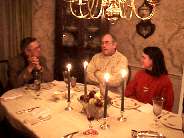 Dinner originally
referred to the largest meal of the day, which was eaten at midday, to give farm
agricultural laborers a rest break and something to sustain them to the end of
the day. However, this meal has always been something of a "movable
feast". During the reign of Henry VIII it was eaten as early as 10
a.m. and then got progressively later until, during the reign of Queen Victoria, it became fashionable to
sit down to dinner at 10 p.m. The extreme lateness of this meal
meant that many people became hungry in the afternoon and that's why teatime
was invented.
Dinner originally
referred to the largest meal of the day, which was eaten at midday, to give farm
agricultural laborers a rest break and something to sustain them to the end of
the day. However, this meal has always been something of a "movable
feast". During the reign of Henry VIII it was eaten as early as 10
a.m. and then got progressively later until, during the reign of Queen Victoria, it became fashionable to
sit down to dinner at 10 p.m. The extreme lateness of this meal
meant that many people became hungry in the afternoon and that's why teatime
was invented. etymologists aren't certain, they lean toward deriving the word from washer
"a person or thing that washes". You see, that word attained
several different meanings, from "a person who washes" to "an
apparatus for washing" to "the cock or outlet valve of a
water-supplying pipe". It is the latter meaning which may be related
to the "disc" meaning. However, there is no recorded path of
meaning change to support this. Interestingly, the "disc" usage
dates from the mid-14th century! Even more interesting is the fact that washer
"one who washes" isn't recorded before the 15th century, though a
hypothetical Old English form wæscere
has been suggested.
etymologists aren't certain, they lean toward deriving the word from washer
"a person or thing that washes". You see, that word attained
several different meanings, from "a person who washes" to "an
apparatus for washing" to "the cock or outlet valve of a
water-supplying pipe". It is the latter meaning which may be related
to the "disc" meaning. However, there is no recorded path of
meaning change to support this. Interestingly, the "disc" usage
dates from the mid-14th century! Even more interesting is the fact that washer
"one who washes" isn't recorded before the 15th century, though a
hypothetical Old English form wæscere
has been suggested.